Indeed Review 2026: 100 Listings Timed, 18-Hour Average Lag
Indeed is free and unmatched for non-tech and hourly jobs. We timed 100 listings: alerts lagged career pages by 18 hours on average, and some took 48.
Indeed is still worth using in 2026, mainly for breadth: it is free, it covers almost every industry, and it is unmatched for non-tech and hourly jobs. Its weak spot is speed, because when we timed 100 listings, Indeed's alerts arrived an average of 18 hours after the job appeared on the company's own career page, and some took 48 hours. This Indeed review covers where it wins, where it falls behind, and what to pair it with if you want to apply early.
I built Scoutify, which watches company career pages directly, so keep that in mind when you read my take on speed.
What Indeed Is
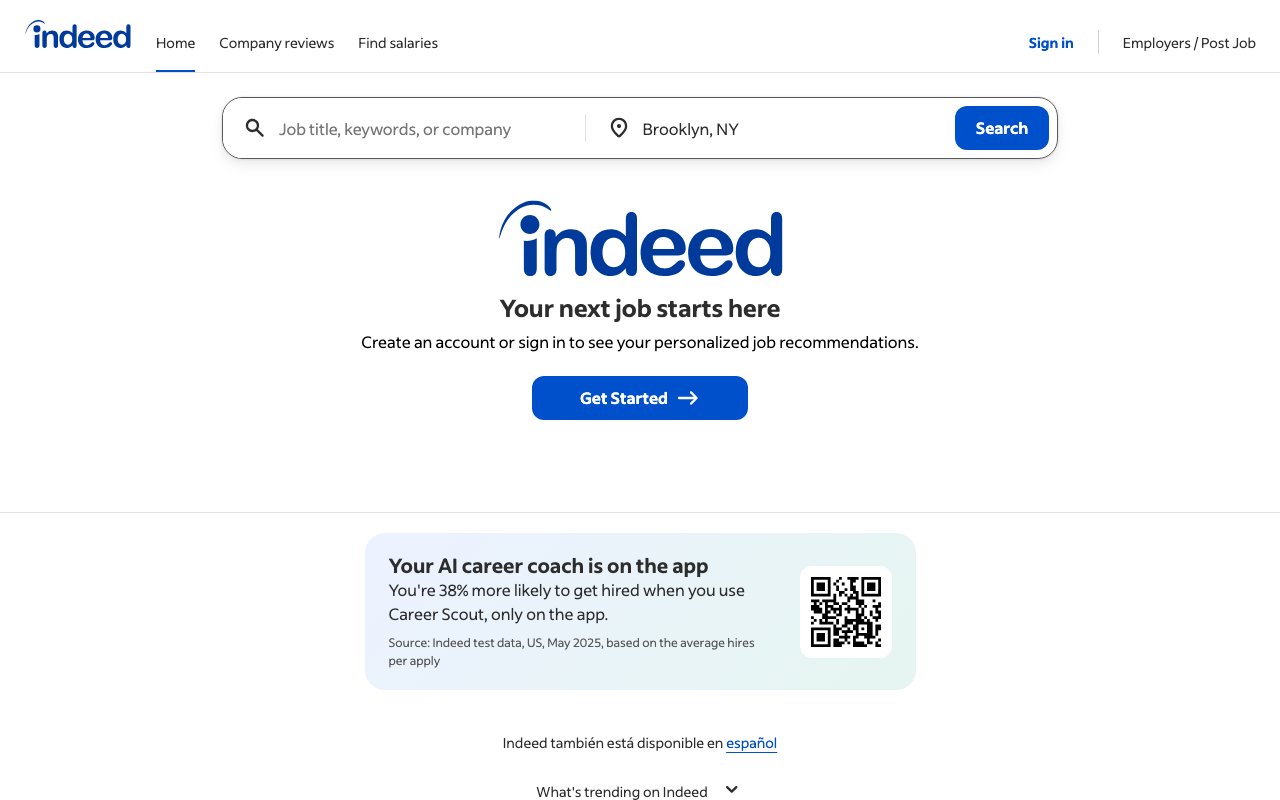
Indeed was founded in 2004 and acquired by Recruit Holdings, the Japanese HR group, in 2012. It works as a job search engine: it aggregates listings from thousands of sources and also lets employers post directly, which gives it one of the broadest job databases in the world across nearly every country, industry and role type.
Indeed makes its money from employers. They can post for free with limited visibility or pay to sponsor listings, which pushes them higher in results. For job seekers, it is free, with no premium tier needed to search or apply.
Key Features
Search and filtering
You enter a title or keyword and a location, then filter by date posted, estimated salary, job type, experience level and company. The "date posted" filter is useful, but the date shown is when Indeed indexed the job, which is not always when the company posted it.
Job alerts
You can create an alert for any search and choose how often to receive it. The alerts pull from the same aggregated index as search, so the same indexing delays apply, and most of them arrive as email.
Indeed Resume, reviews and salary data
You can upload your resume and make it searchable, which can bring inbound recruiter interest in high-demand fields. Indeed also hosts company reviews and salary reports, and many listings show salary estimates, although those estimates are often generated by Indeed rather than provided by the employer, so they are rough guides.
Indeed Apply
Like LinkedIn's Easy Apply, Indeed Apply lets you submit with your Indeed profile and resume, while some listings send you to the employer's site instead. The trade-off is the same as on LinkedIn: lower friction means more applicants per listing.
Strengths
- The coverage is massive. Indeed aggregates from more sources than almost any other platform, so a job posted anywhere online will probably appear there eventually.
- It reaches every industry. Retail, hospitality, healthcare, trades, engineering and executive roles all appear, which makes it valuable if you are open to several fields.
- It is free for job seekers. Search, apply and alerts cost nothing.
- The interface is focused. Indeed is more utilitarian than LinkedIn's feed, so it is easier to concentrate on listings.
- Salary estimates help you screen. Many listings show a range, which gives you a quick sense of pay before you apply.
Weaknesses
- Alerts lag behind career pages. Indeed crawls or receives employer feeds, indexes the listings, matches them to alerts and batches them, and our 100-listing test averaged 18 hours of lag.
- Duplicates and expired listings are common. The same job can appear several times under different titles, and filled roles linger.
- The signal-to-noise ratio is low. Volume brings irrelevant results, and staffing agency posts often dominate popular keywords.
- It is weaker for tech. Indeed's strength is high-volume hiring, so specialized roles at startups and mid-stage companies are better targeted elsewhere.
- Sponsored listings get priority. Organic listings from companies with small recruiting budgets are harder to find.
The 18-Hour Average Lag: The Aggregation Problem
Indeed's timing follows the pattern of every aggregator. At hour 0, the company posts the job on its career page. Over the next 1 to 12 hours, Indeed's crawlers discover it, with large employers crawled more often than small ones. Between hours 6 and 24, the listing is indexed and made searchable, and the alert goes out in the next batch, anywhere from 12 to 48 hours after the original posting.
In our test of 100 listings, the average lag was 18 hours, and some listings took 48 hours. The lag is also inconsistent, because a Google job might reach you within 12 hours while a posting from a 200-person startup could take days. Tools that watch career pages directly check every company on the same schedule, so they deliver minutes after posting regardless of employer size.
Who Indeed Works Best For
- Broad job seekers who are open to several industries and role types will find Indeed's breadth hard to beat.
- Candidates in healthcare, education, retail, manufacturing and service roles will often find the best coverage on Indeed.
- Salary researchers can use the estimates as benchmarks, even though the numbers are not always precise.
- Passive searchers who do not need speed can use the alert emails as a low-effort way to watch the market.
Who Should Add Something Faster
- Tech candidates targeting competitive roles will find an 18-hour average lag too slow when early applications matter.
- Startup-focused seekers will find early-stage companies underrepresented compared with Wellfound or tools that watch career pages directly.
- People tired of duplicates and ghost listings will find that Indeed's aggregation model amplifies those problems.
Can Indeed Apply to Jobs for You?
Indeed Apply makes applying faster, but you still find each job and submit it yourself, and you do it after the listing has already reached Indeed. Scoutify's Sniperworks from the other end. Scoutify watches 70,000+ company career pages, and when a new job that fits your roles, locations and visa needs appears on a Workday, Greenhouse or SmartRecruiters career site, Sniper submits the employer's real application with your resume, usually within minutes of the posting. It does not apply through Indeed or LinkedIn, and it sends one application per posting. Most employers send a confirmation email, and those confirmations and replies land in Scoutify Mail.
If you only want to know about new jobs sooner and apply yourself, Scoutify's real-time job alerts cost $5 a week. Sniper costs $25 a week for up to 500 applications, and your first 25 applications are free.
Pricing
Indeed is free for job seekers, including search, Indeed Apply, alerts and a searchable resume, and there is no premium candidate tier as of September 30, 2026. Indeed earns its money from employers through sponsored listings.
Indeed vs LinkedIn vs ZipRecruiter vs Scoutify: 2026 Comparison
| Feature | Indeed | ZipRecruiter | Scoutify | |
|---|---|---|---|---|
| Alert speed | 18-hour average in our test | 31-hour median in our test | 8 to 12 hours | Minutes (push) |
| Job coverage | Massive, all industries | Large, all industries | Large, all industries | 70,000+ career pages |
| Applies for you | No (Indeed Apply, you submit) | No (Easy Apply, you submit) | No (1-Click Apply, you submit) | Yes, Sniper on supported career sites |
| Price for job seekers | Free | Free; Premium $29.99 to $39.99 a month | Free | Browse free; Alerts $5, Sniper $25 a week |
| Networking | None | Strong | None | None |
| Best for | Broad coverage | Networking and research | AI matching | Applying first on career sites |
Frequently Asked Questions
Is Indeed free for job seekers in 2026?
Indeed is completely free for job seekers. Search, Indeed Apply, alerts and resume uploads cost nothing, and Indeed earns its money from employers through sponsored listings.
How fast are Indeed job alerts?
Indeed's alerts are not real time. In our test of 100 listings, they arrived an average of 18 hours after the job appeared on the company's career page, and some took 48 hours, because Indeed has to crawl, index and match each listing first.
Is Indeed worth using in 2026?
Indeed is worth using for its breadth, especially for non-tech, hourly and cross-industry searches. For tech roles where timing matters, it works best next to a tool that watches company career pages directly.
What are the best Indeed alternatives in 2026?
For speed, Scoutify watches 70,000+ career pages, sends alerts within minutes and, on its Sniper plan, applies for you. Wellfound is stronger for startups, LinkedIn is better for networking, and HiringCafe offers clean searching across career pages.
Verdict
Indeed does what it was built to do: it gathers a huge volume of listings into one free, searchable place, and for broad searches outside tech it remains a solid default. Its limits are an 18-hour average alert lag, duplicate listings and sponsored placements that crowd the results.
For tech professionals who target specific companies, I would use Indeed as a supplementary source and let Sniper apply to new jobs on company career sites before they reach Indeed. For more options, see our list of Indeed alternatives.
We rate Indeed 3 out of 5 for job alerts specifically, because it is strong on coverage and price and weak on speed and signal-to-noise ratio.
Related Reviews and Guides
- Our LinkedIn Jobs review times the other big board.
- Our ZipRecruiter review covers the AI-matching marketplace.
- The job search tool comparison matrix puts 20+ tools in one table.
Written by
Jules Lemée
Founder of Scoutify
Founder of Scoutify. Has worked as a cloud engineer, software engineer, and ML researcher, while also leading product and go-to-market at startups. Serial tech entrepreneur since age 13, with ventures reaching tens of thousands of users.
Stop refreshing LinkedIn.
Browse the job board free, no account needed. Real-time alerts from 70,000+ company career pages start at $5/week, so your phone buzzes the minute a matching job goes live.
BROWSE JOBS - FREE