LazyApply Review 2026: Is It Legit? 200 Apps, 0.5% Callback Rate
Is LazyApply legit? It costs $99 to $999 a year and rates 2.1/5 on Trustpilot. I ran 200 apps, and the mass-spray hit a wall fast: ATS spam flags and a 0.5% callback rate.
Is LazyApply legit? LazyApply is a real product that does send applications in bulk through LinkedIn Easy Apply, Indeed and other job boards, but it is a weak buy for most people: it rates 2.1 out of 5 on Trustpilot, and when I ran 200 applications through it, the mass-spray approach hit a wall fast, with ATS spam flags and a 0.5% callback rate. It costs $99, $149 or $999 a year for 15, 150 or 1,500 applications a day. This LazyApply review covers how it works, what reviewers report, whether it is safe for your LinkedIn account, and when a tool that sends fewer, better-timed applications is the better choice.
I am the founder of Scoutify, and our Sniper auto-apply plan competes with LazyApply, so you should read my opinion with that in mind. The two tools make opposite bets. LazyApply bets on volume, which means sending as many applications as possible to whatever is already listed on the boards. Sniper bets on fit and timing: Scoutify watches 70,000+ company career pages, and Sniper applies with your real resume to new jobs that match you, minutes after they post. I will say plainly where LazyApply is still the better tool, because there is a case for it.
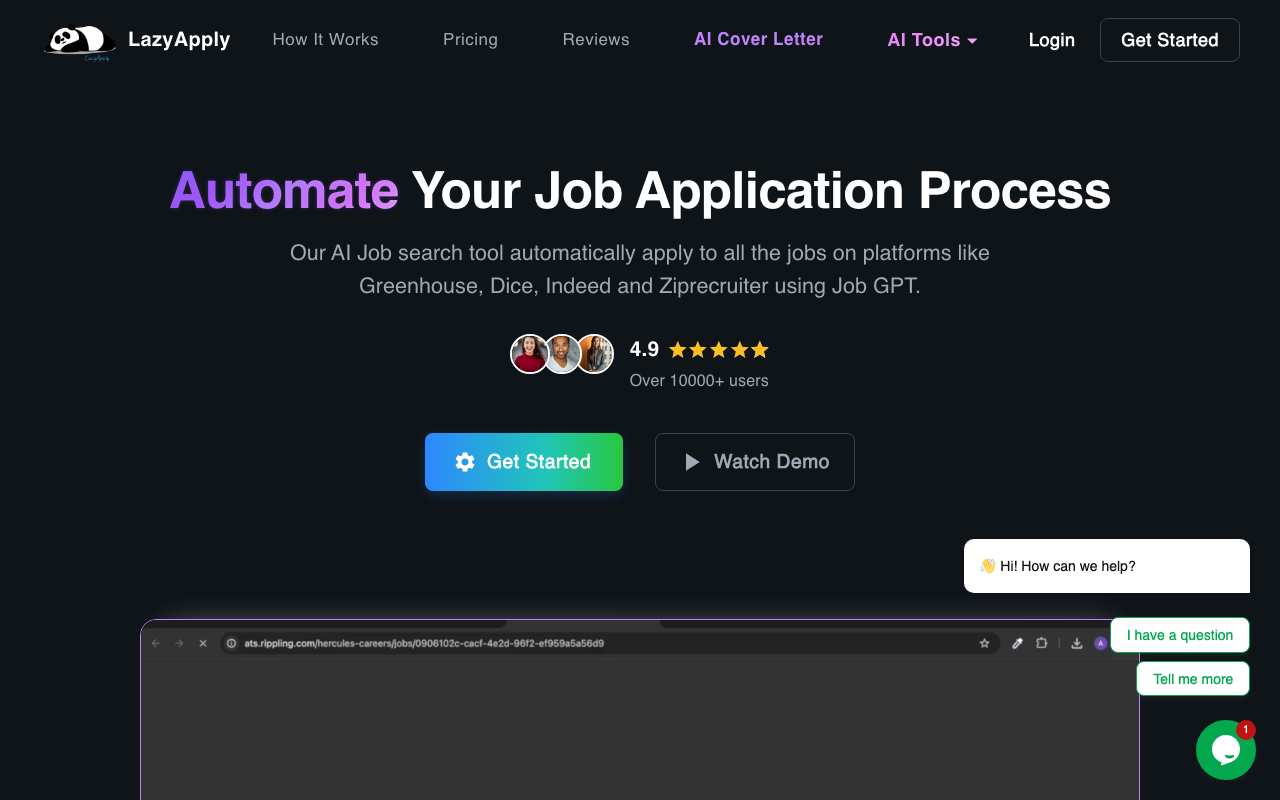
Is LazyApply Legit?
LazyApply is legit in the sense that it is a working product you can buy, and it does submit applications. It is not legit in the sense most people mean when they ask, which is whether it will get them interviews without causing trouble, and the public reviews say it often does not.
On Trustpilot, LazyApply had a TrustScore of 2.1 out of 5 from 110 reviews when we checked on September 30, 2026, with 58% of the reviews at one star and 37% at five stars. That is a polarized split: a group of users is happy with the volume, and a larger group says the tool failed them or that they could not get their money back.
How LazyApply Works
LazyApply is a Chrome extension with a web dashboard. You create a profile with your resume and answers to common questions, set job titles and locations, and start it on a job board. The extension then searches the board, opens each listing, fills in the form with its "Job GPT" engine and clicks submit, one listing after another. Third-party listings of the product name LinkedIn Easy Apply, Indeed, ZipRecruiter, Glassdoor, Monster, Greenhouse and Dice as supported sites, and its own homepage currently names Greenhouse, Dice, Indeed and ZipRecruiter.
Because it works inside your browser, it applies through your own logged-in job board accounts. That is the detail that matters most for LinkedIn, and I come back to it below. LazyApply also includes AI tools that suggest resume keywords, generate cover letters and give LinkedIn profile tips, although those extras tend to be generic and add little to the application.
The volume claims have changed over the years. LazyApply has advertised 750 applications a day on its higher plans and up to 1,000 jobs "in just a single click", and its pricing page now lists up to 1,500 a day on the Ultimate plan.
LazyApply Pricing
LazyApply sells annual plans that it markets as one payment for a year of access. On September 30, 2026, its pricing page listed these three plans:
- The Basic plan costs $99 a year and allows 15 applications a day with 1 resume profile.
- The Premium plan costs $149 a year and allows 150 applications a day with 5 resume profiles.
- The Ultimate plan costs $999 a year and allows 1,500 applications a day with 20 resume profiles.
There is no free plan and no free trial. The pricing page offers a 30-day refund policy if you ask within 30 days of purchase, although several reviewers say they could not get a reply to their refund request. The annual price looks cheap next to monthly subscriptions, and per application it is very cheap, but that only holds if the applications actually go through and reach the right jobs.
What Happened When I Ran 200 Applications
I ran 200 applications through LazyApply. The mass-spray approach hit a wall fast: applications triggered spam flags on applicant tracking systems, and the callback rate was 0.5%, which works out to one callback from 200 applications.
That result is what I would expect from the volume approach, and it is why Sniper works the other way. A job that has been on LinkedIn or Indeed for a day already has hundreds of applicants, so one more generic application at the back of that pile rarely gets read. Sending 150 of those a day does not change the math much, and it adds risk, because recruiters and their systems notice when one person applies to everything.
What LazyApply Promises About Your LinkedIn Account
LazyApply's site says: "Our scripts use ADVANCED AI JOB SEARCH ALGORITHMS, so your profiles will never get blocked by platforms." I would not rely on that. LinkedIn's User Agreement says that members may not use "bots or other unauthorized automated methods to access the Services", and LinkedIn keeps a help page on prohibited software and extensions. A tool that clicks Easy Apply hundreds of times a day from your account is the kind of activity those rules describe, and no algorithm can promise how LinkedIn will respond.
Large platforms put a lot of effort into spotting automated behavior, and users have reported LinkedIn accounts that were flagged, restricted or banned after using LazyApply. Losing your LinkedIn account in the middle of a job search is a serious setback. Our guide to LinkedIn auto apply covers the rules in more detail.
What Trustpilot Reviewers Report
The one-star reviews on Trustpilot repeat three complaints.
- The form fills fail. One reviewer wrote that "on my first 25 applications it could not even enter my First Name and/or Last Name", and others describe wrong dropdown choices and incomplete submissions. A broken application to a company you care about can be worse than no application at all.
- The filters are ignored. Reviewers say their job filters returned irrelevant results, so the tool applied to roles they never wanted.
- Refunds and support are hard to reach. Several reviewers say their emails about refunds or bugs went unanswered for weeks, and one wrote that the response to repeated emails was "absolute silence."
LazyApply also gives you no real way to check that an application went through. You might think you applied to 100 jobs when a large share were incomplete, incorrect or filtered out on arrival.
What We Like
- It reaches many job boards from one tool, including LinkedIn, Indeed, ZipRecruiter and Glassdoor.
- The annual price is low, and at $99 to $149 a year it works out to about $8 to $12 a month for most users.
- The Chrome extension is easy to install, and the profile setup does not take long.
Where It Falls Short
- Form-filling errors are common, especially on custom questions and dropdowns, according to both our test and the reviews.
- It puts your job board accounts at risk, because mass automation conflicts with the terms of LinkedIn and most other boards.
- It has no proof of submission, so you cannot tell which applications actually reached an employer.
- Support is slow or absent, according to many recent reviews.
- Every application uses the same resume and a templated cover letter, and recruiters at competitive companies can spot mass-applied submissions.
- Applying to many jobs at one company can make you look like a spam applicant to the employers you actually want.
LazyApply vs Sniper
The honest comparison is volume against fit. LazyApply sends as many applications as possible to jobs that are already on the boards. Sniper sends complete applications only to new jobs that match your roles, locations and visa needs, on the employer's own career site, minutes after they post, and the employer's confirmation email is the proof.
| Question | LazyApply | Scoutify Sniper |
|---|---|---|
| How soon after posting it applies | Whenever you run it, on jobs already listed on the board | Minutes after the job posts on the career site |
| Where it applies | LinkedIn Easy Apply, Indeed and other job boards, through your logged-in accounts | Employer career sites on Workday, Greenhouse and SmartRecruiters (Ashby and Lever rolling out); never on linkedin.com |
| Proof of submission | A count in its dashboard | The employer's confirmation email, in Scoutify Mail |
| One application per posting | Not a published guarantee | Yes |
| Price per application | $99 to $999 a year for 15 to 1,500 a day (under 2 cents each at the cap) | $25/week for up to 500 (5 cents each at the cap); Auto Apply $15/week for up to 200 |
Sniper works around the clock, so it applies while you sleep, and it never logs in to your LinkedIn account. It sends one application per posting, it uses your real resume rather than a rewritten one, and the employer's confirmation and any replies land in Scoutify Mail. Between August 27 and September 25, 2026, 68% of Sniper applications received the employer's own confirmation email, with a median of 1.2 minutes between submission and email. You can read what those emails tell you in our guide to job application confirmation emails.
LazyApply is the better choice in one situation, and I want to be clear about it. If you want sheer volume on job boards that Sniper does not support, such as LinkedIn Easy Apply, Indeed or ZipRecruiter, and you accept the risk to those accounts, LazyApply reaches jobs that Sniper never will, and it does so for less money per application. Sniper applies only on supported career sites, it caps at 500 applications a week, and it does not write cover letters.
Sniper costs $25 a week for up to 500 applications, Auto Apply costs $15 a week for up to 200, and Alerts cost $5 a week if you would rather apply yourself. Your first 25 applications are free, with no card. For a longer head-to-head, see Scoutify vs LazyApply, and for the evidence on volume against timing, see does auto apply work.
Who Should Use LazyApply?
It is hard to recommend LazyApply to most people, given the reviews and the account risk. It can make sense if you are applying to non-competitive, high-volume roles where volume matters more than personalization, such as entry-level retail, hospitality or general labor. It can also make sense if you do not mind risking the job board accounts you use with it, and if you treat it as a supplement to your own applications rather than a replacement.
For software engineers, product managers, data scientists and anyone else targeting competitive roles at good companies, mass auto-apply is likely to do more harm than good.
LazyApply Alternatives
If you came here looking for LazyApply alternatives, these four tools each take a different approach. The full ranking is in the best auto-apply tools in 2026.
Scoutify Sniper: Best for Applying First
Sniper is the opposite of LazyApply. Instead of sending hundreds of generic applications to old listings, it watches 70,000+ company career pages and applies with your real resume to new jobs that fit your filters, minutes after they post, with the employer's confirmation email as proof. It costs $25 a week, and your first 25 applications are free.
JobCopilot: Best for Career-Page Auto-Apply at Volume
JobCopilot applies on company career pages rather than through your job board accounts, and it can send up to 50 applications a day. It looks for new jobs posted daily, and its pricing page listed plans at $0.93 to $1.05 a day on September 30, 2026. Its Trustpilot rating was 2.1 out of 5 from 96 reviews on the same date, which is no better than LazyApply's. See our JobCopilot review.
AIApply: Best for a Writing Toolkit Plus Auto-Apply
AIApply writes a tailored resume and cover letter for each job and applies through job boards and company portals. Its Premium toolkit costs about $29 a month, and auto-apply is sold as credits on top, so 100 applications a month comes to about $68. It had a Trustpilot rating of 4.2 from 1,843 reviews on September 29, 2026. See our AIApply review.
Simplify: Best for Autofill Without the Risk
Simplify's free Chrome extension fills in application forms on Greenhouse, Lever, Workday and other systems, and it leaves the submit click to you, so you catch errors before they reach an employer. Its paid Simplify+ plan adds AI resume tailoring. See our Simplify review.
Is LazyApply Worth the Money?
LazyApply's idea is appealing, because it promises to automate the most painful part of a job search. In practice, the form-filling errors, the risk to your job board accounts, the missing support and the low quality of mass applications make it a risky bet, and my 200-application run ended with one callback. The 2.1 Trustpilot rating reflects real frustration from real users.
Before you spend $99 or $149, I would ask whether your search needs more applications or earlier ones. If it needs earlier ones, try Sniper with 25 free applications: it applies to fewer jobs, but each one is a new posting that fits your filters, sent minutes after it goes live, with proof that it arrived. If you only want to know about new jobs and apply yourself, Scoutify's job alerts cost $5 a week.
Frequently Asked Questions
Is LazyApply legit?
LazyApply is a real product that submits applications in bulk, but it had a 2.1 out of 5 TrustScore from 110 Trustpilot reviews on September 30, 2026. Most complaints concern failed form fills, ignored filters and refunds that were hard to get.
Is LazyApply worth the money?
LazyApply is worth the money only if you want sheer volume on job boards like LinkedIn Easy Apply and Indeed and you accept the risk to those accounts. When we ran 200 applications through it, the callback rate was 0.5%, so for competitive roles I would spend the money on applying earlier rather than more often.
Is LazyApply free?
LazyApply is not free. It has no free plan or trial, its plans cost $99, $149 or $999 a year, and its pricing page offers a 30-day refund policy if you ask within 30 days of purchase.
How does LazyApply work?
LazyApply is a Chrome extension that searches job boards such as LinkedIn, Indeed and ZipRecruiter from your logged-in accounts, fills in each application from your saved profile and submits it. The number of applications it can send depends on your plan, from 15 to 1,500 a day.
Which is better, LazyApply or JobCopilot?
JobCopilot is better for most people, because it applies on company career pages instead of your job board accounts and it matches jobs to your profile before applying. LazyApply is cheaper per application and reaches LinkedIn Easy Apply and Indeed, and both tools rated about 2 out of 5 on Trustpilot in September 2026.
More Tool Reviews
- The best auto-apply tools in 2026 ranks every tool that applies for you.
- Our Scoutify vs LazyApply comparison goes deeper on volume against timing.
- Our JobCopilot review covers career-page auto-apply.
- Our AIApply review covers credit-based auto-apply with AI-written materials.
- Our article on whether AI can apply to jobs for you explains what these tools can and cannot do.
- Our Simplify review covers a free autofill extension.
Written by
Jules Lemée
Founder of Scoutify
Founder of Scoutify. Has worked as a cloud engineer, software engineer, and ML researcher, while also leading product and go-to-market at startups. Serial tech entrepreneur since age 13, with ventures reaching tens of thousands of users.
Stop refreshing LinkedIn.
Browse the job board free, no account needed. Real-time alerts from 70,000+ company career pages start at $5/week, so your phone buzzes the minute a matching job goes live.
BROWSE JOBS - FREE