CareerBuilder Review 2026: Traffic Down 60%, Worth It?
CareerBuilder peaked in 2010, lost 60% of its traffic and was sold out of bankruptcy in 2025. It still helps in healthcare and logistics but not in tech.
CareerBuilder is still worth a periodic check if you work in healthcare, manufacturing, logistics or hourly roles, and it is mostly a waste of time for tech. It peaked around 2010, its monthly traffic is down roughly 60% from its 2018 peak, and after the combined CareerBuilder + Monster filed for bankruptcy in June 2025, its job board was sold to Bold. This CareerBuilder review covers what it still offers in 2026, where it has fallen behind, and what to use instead.
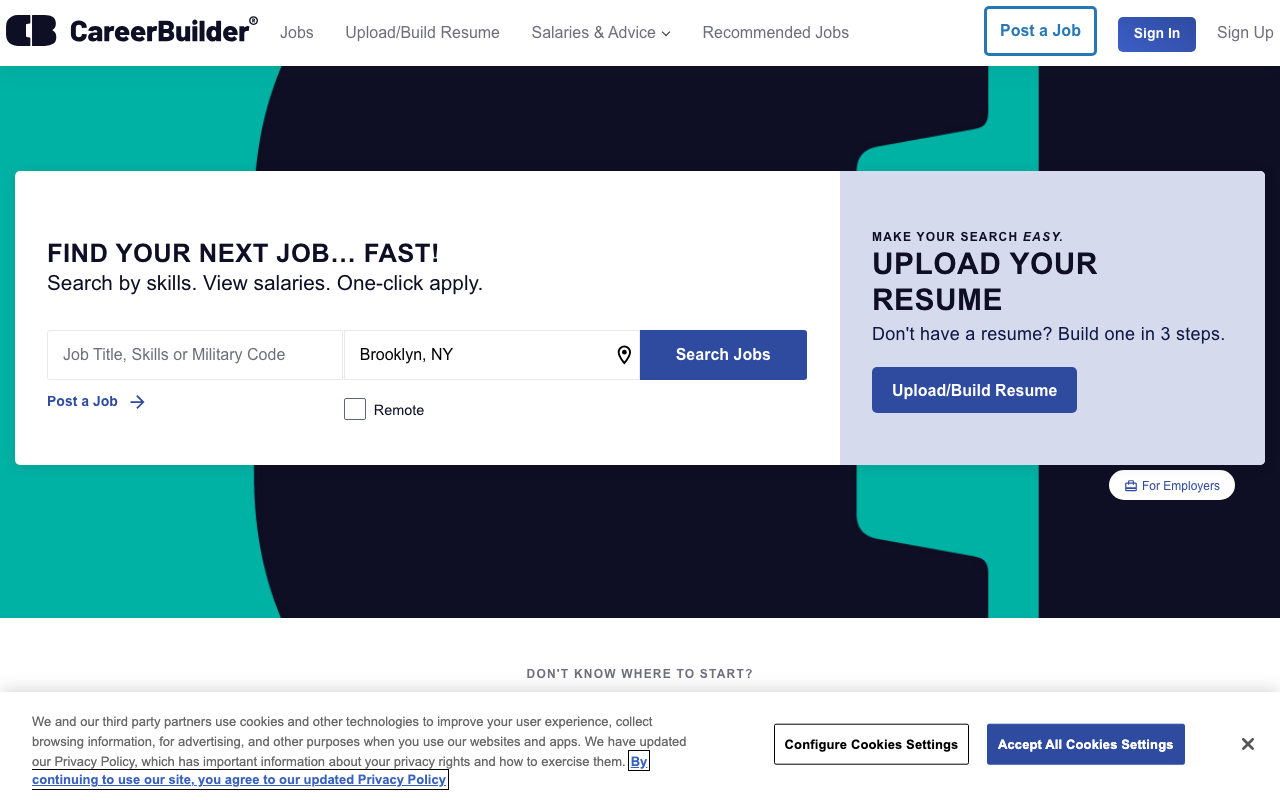
What Happened to CareerBuilder
CareerBuilderwas founded in 1995, ran Super Bowl ads, and at its peak was one of the three largest job sites in the United States, alongside Monster and Indeed. Apollo Global Management bought it in 2017, and the company shifted its investment toward HR software and employer data products, so the job seeker experience received little attention. SimilarWeb data shows CareerBuilder's monthly visits down roughly 60% from their 2018 peak, while Indeed and LinkedIn grew.
CareerBuilder merged with Monster in 2024, and the combined CareerBuilder + Monster filed for Chapter 11 bankruptcy on June 24, 2025. In the auction that followed, Bold, the company behind resume tools such as ResumeBuilder.com and the auto-apply service Sonara, won the job board business with a bid of about $28.4 million, and the company said the sales closed on July 31, 2025. The CareerBuilder brand and board still operate under that new ownership in 2026. Our Sonara review covers the auto-apply service that now shares an owner with CareerBuilder.
Key Features
Broad industry coverage
CareerBuilder lists jobs in healthcare, manufacturing, retail, logistics, finance, government, education and technology. For non-tech industries and smaller cities, its coverage is still broader than tech-focused boards such as Dice or Wellfound.
AI matching and recommendations
CareerBuilder recommends jobs from your resume, search history and preferences, and it matches candidates for employers. The quality is mixed: it works for generalist titles such as sales representative or project manager, and it struggles with niche roles such as MLOps engineer, where recommendations are often only loosely related.
Mobile app, resume builder and salary data
The iOS and Android apps offer search, saved searches and push notifications for new matches, although they feel less polished than the Indeed or ZipRecruiter apps. The resume builder and career articles are serviceable, and salary data is decent for common roles in large metros and thin elsewhere.
CareerBuilder for Employers
Employers can post single jobs or use bulk posting, buy sponsored placement, search the resume database, run programmatic job ads and, at larger sizes, use a talent acquisition suite with tracking and analytics. The resume database was once CareerBuilder's crown jewel, with millions of resumes, but its value has eroded because many resumes are years old and active job seekers now keep LinkedIn profiles instead. Recruiters who still use it tend to treat it as one source for non-tech roles, next to LinkedIn Recruiter for tech.
CareerBuilder Pricing
CareerBuilder is free for job seekers, with no premium candidate tier. Before the 2025 sale, employer pricing was reported to start around $375 a month for a single job posting, with resume database access from about $500 to $800 a month, sponsored listings from about $5 to $10 a day, and custom enterprise pricing that typically ran above $10,000 a year. We could not confirm current employer prices on September 30, 2026, so employers should ask CareerBuilder for a quote. Many employers have reported better returns from Indeed Sponsored Jobs or LinkedIn Recruiter, which is part of why they moved their budgets.
What We Like
- Non-tech coverage still has value. Healthcare, manufacturing, logistics and retail roles are well represented, often in smaller cities and towns.
- Long-time employers still post there. Some large employers in traditional industries post on CareerBuilder out of habit, so you may find listings that newer boards miss.
- It is good for entry-level and hourly work. CareerBuilder carries a meaningful volume of entry-level, hourly and blue-collar positions.
- It is free for job seekers. There is no barrier to searching or applying.
Where It Falls Short
- Its listing volume keeps falling. Many employers have moved their posting budgets to Indeed, LinkedIn and ZipRecruiter.
- Listing quality is uneven. Duplicates, expired roles and agency posts that may not match a real opening are common.
- Alerts are not real time. Job alerts arrive by email on a periodic schedule, with no way to hear about a posting within minutes.
- It is weak for tech. Startups and modern product companies rarely post there, so engineers, data scientists and product managers will find a thin, stale catalog.
- The experience feels dated. Navigation is clunky, and the design has not kept pace with newer platforms.
CareerBuilder vs Indeed vs LinkedIn vs Scoutify: 2026 Comparison
| Feature | CareerBuilder | Indeed | Scoutify | |
|---|---|---|---|---|
| Alert speed | Periodic email | 18-hour average in our test | 31-hour median in our test | Minutes (push) |
| Tech job volume | Low, declining | High | High | 70,000+ companies watched |
| Non-tech job volume | Medium | Very high | High | Companies with career sites |
| Applies for you | No | No | No | Yes, Sniper on supported career sites |
| Price for job seekers | Free | Free | Free; Premium optional | Browse free; Alerts $5, Sniper $25 a week |
| Data source | Employer postings | Aggregated and direct | Employer postings and ATS feeds | Company career pages directly |
| Best for | Non-tech, hourly roles | Broad coverage | Networking and research | Applying first on career sites |
Which Should You Use?
- If you work in tech, you can skip CareerBuilder, use LinkedIn for networking, and let Scoutify watch 70,000+ company career pages for you.
- If you work in healthcare, manufacturing or logistics, CareerBuilder still has meaningful coverage, and it works best next to Indeed.
- If you want entry-level or hourly work, CareerBuilder is a reasonable third or fourth source alongside Indeed and local boards.
- If speed matters, CareerBuilder's email alerts are too slow, and a tool that applies minutes after a job posts will serve you better.
Frequently Asked Questions
Is CareerBuilder still worth using in 2026?
CareerBuilder is worth a periodic check for non-tech industries such as healthcare, manufacturing and logistics, where it still has employer relationships. For tech roles, its listings are too sparse and its alerts too slow to be a main tool.
What happened to CareerBuilder?
CareerBuilder merged with Monster in 2024, and CareerBuilder + Monster filed for Chapter 11 bankruptcy in June 2025. Bold won the job board business at auction, the sales closed on July 31, 2025, and the CareerBuilder site still operates under Bold.
How much does CareerBuilder cost for employers?
Before the 2025 sale, employer pricing was reported to start around $375 a month for a single job posting, with resume database access from about $500 to $800 a month. We could not confirm current prices on September 30, 2026, so employers should request a quote.
Does CareerBuilder have AI job matching?
CareerBuilder offers AI matching for employers and job recommendations for seekers. The quality is inconsistent, and it works better for generalist titles than for specialized roles.
How does CareerBuilder compare to Indeed and LinkedIn?
Indeed has far more listings across all industries, and LinkedIn has the strongest networking features. CareerBuilder has declined in both volume and relevance, and all three are slower than tools that watch company career pages directly.
What are the best CareerBuilder alternatives?
Indeed and LinkedIn offer more listings, and Scoutify watches 70,000+ company career pages and sends alerts within minutes of a posting. Scoutify's Sniper plan also applies for you on supported career sites.
The Bottom Line
CareerBuilder's fall from market leader to a brand sold out of bankruptcy is one of the clearest cautionary tales in job search. It still has value for non-tech industries, entry-level roles and smaller markets, so it is worth an occasional look if that is your field.
For most professional job seekers, and for anyone in tech, I would spend the time elsewhere. If you want to be early on new jobs at the companies you care about, Sniper applies on the employer's career site minutes after a matching job posts, through Workday, Greenhouse and SmartRecruiters, and your first 25 applications are free. If you would rather apply yourself, Scoutify's job alerts cost $5 a week.
Related Reviews and Guides
- Our Indeed review covers the board that took most of CareerBuilder's traffic.
- Our ZipRecruiter review covers another broad marketplace.
- The job search tool comparison matrix puts 20+ tools in one table.
Written by
Jules Lemée
Founder of Scoutify
Founder of Scoutify. Has worked as a cloud engineer, software engineer, and ML researcher, while also leading product and go-to-market at startups. Serial tech entrepreneur since age 13, with ventures reaching tens of thousands of users.
Stop refreshing LinkedIn.
Browse the job board free, no account needed. Real-time alerts from 70,000+ company career pages start at $5/week, so your phone buzzes the minute a matching job goes live.
BROWSE JOBS - FREE