Jobscan Review 2026: Is It Worth It? A/B Tested on 80 Applications
Jobscan scores your resume against a job post. We sent 40 high-score and 40 low-score versions, and the callback lift was real but smaller than Jobscan claims.
Jobscan is worth trying for free, and worth paying for only during an active search aimed at large companies with formal applicant tracking systems. It compares your resume with a job description and gives you a match score and a list of missing keywords. We sent 40 high-score and 40 low-score versions of a resume to similar roles, and the callback lift from the higher score was real but smaller than Jobscan claims. This Jobscan review covers how it works, what it costs in 2026, and how to use it without turning your resume into a keyword list.
What Is Jobscan?
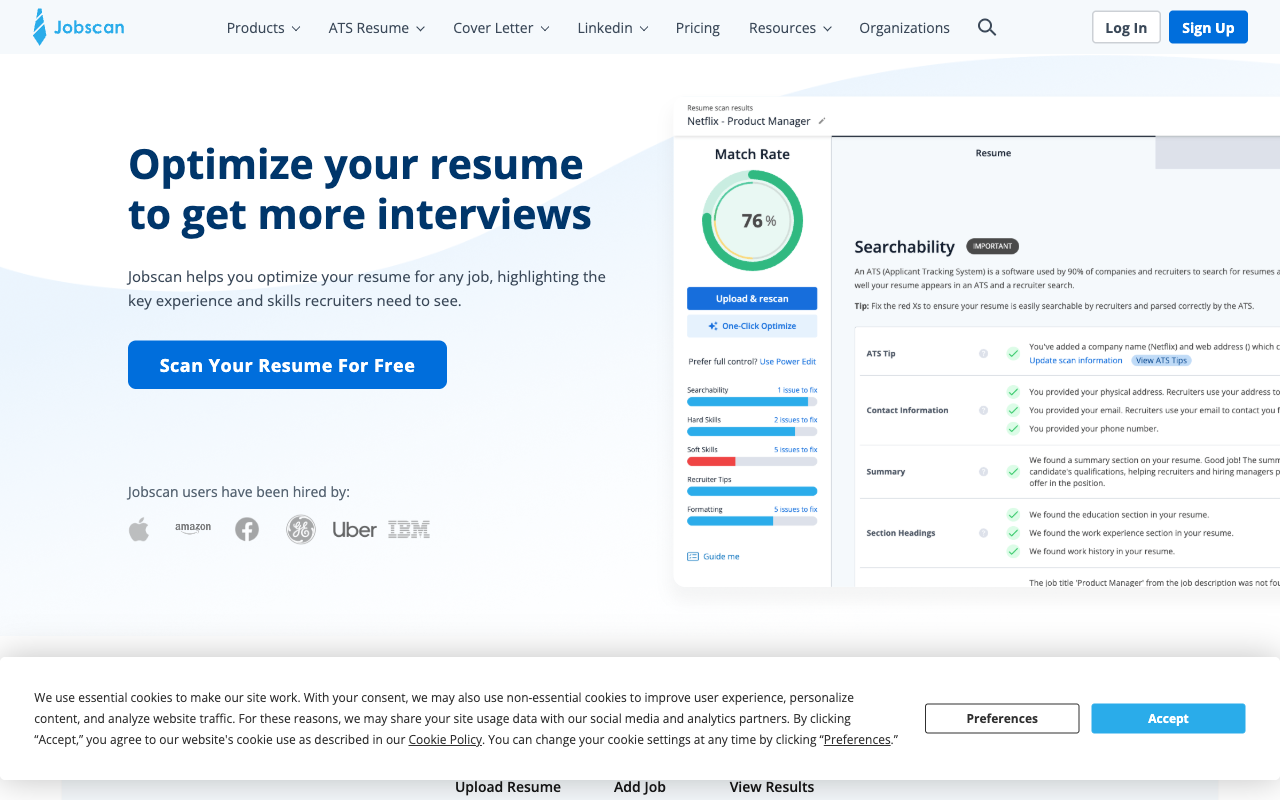
Jobscan was founded in 2014 by James Hu after he applied to dozens of jobs and heard nothing back. His insight was that applicant tracking systems sort resumes by keywords, formatting and section structure, so a qualified candidate can be filtered out before a recruiter ever reads the resume. Jobscan scans your resume and a job description side by side, shows which keywords you have and which you are missing, and checks how your formatting will parse in systems such as Workday, Greenhouse, iCIMS, Lever and Taleo.
What Our 80-Application Test Showed
We made two versions of the same resume, one that scored high on Jobscan and one that scored low, and sent 40 of each to similar roles. The high-score version did earn more callbacks, so the effect is real, but the lift was smaller than Jobscan's marketing suggests. That suggests keyword match helps at the margin, and that a high score alone will not carry an application.
Key Features
Resume match score
You upload your resume, paste a job description and get a percentage match, with the hard skills, soft skills and other keywords from the posting marked as found or missing. Jobscan recommends aiming for a score above 80%, which it says correlates with more interview callbacks.
Keyword and formatting analysis
Jobscan separates hard skills such as Python or SQL from soft skills such as leadership and from job-specific terms such as sprint planning, so you can see what to add or emphasize. It also flags tables, text boxes, headers, images and unusual fonts that can break parsing, which catches problems most people never see in a PDF viewer.
LinkedIn optimization and resume builder
Premium applies the same keyword matching to your LinkedIn headline, summary and skills, and it includes a resume builder with plain, ATS-friendly templates. Both are useful starting points, although LinkedIn ranks profiles on far more than keywords.
Jobscan Pricing
As of September 30, 2026, Jobscan's free plan includes 5 resume scans a month, and Premium costs $49.95 a month or $89.95 a quarter, which works out to about $30 a month. Premium adds unlimited scans, AI rewriting of bullet points, LinkedIn and cover letter optimization, the resume builder and a job tracker. Five free scans are enough to tailor your top applications, and Premium makes sense if you tailor 20 or more applications a month.
What We Like
- The feedback is specific. You see exactly which words to add and where, which turns resume tailoring into a concrete task.
- It knows how ATS platforms parse resumes. The formatting check catches invisible characters and section headers that tracking systems cannot read.
- It makes per-application tailoring faster. Seeing what a posting emphasizes lets you adjust quickly instead of sending one generic version everywhere.
- The free tier is useful. It includes the core score and keyword analysis, so you can judge the tool before paying.
Where It Falls Short
- It invites keyword stuffing. A resume that scores 95% but reads like a keyword dump will not impress the person who reads it.
- It does not improve your writing. Jobscan will not tell you that "Responsible for managing a team" is weaker than "Led a 12-person team that shipped 3 products in 6 months."
- Premium is expensive month to month. At $49.95 a month, it costs more than Rezi at $29 a month, which combines AI writing with ATS checks.
- The score can become a distraction. In our test, a higher score helped less than Jobscan suggests, so chasing the last few points is rarely worth the time.
How Jobscan Fits With Applying Early
Jobscan improves the resume, and it does nothing about when your application arrives. I think the better workflow is to use Jobscan to build a few strong, targeted versions of your resume, one for each kind of role you want, and then let a tool send the right one quickly. Scoutify's Sniperdoes that: on the Sniper plan you can upload up to 100 resumes, and when a new job that fits you posts on a Workday, Greenhouse or SmartRecruiters career site, Sniper picks the best-fit resume and submits the employer's real application, usually within minutes of the posting. Sniper costs $25 a week for up to 500 applications, and your first 25 applications are free.
Who Should Use Jobscan?
- Candidates who apply widely and hear nothing back should run a few scans, because an ATS parsing problem may be the cause.
- Job seekers applying to large companies with formal ATS workflows, such as Fortune 500, enterprise tech, healthcare and finance employers, will get the most value.
- People changing industries can use it to translate their experience into a new set of keywords.
It is less necessary if you apply mostly to small startups that read resumes by hand, or if a professional writer has already optimized your resume for ATS parsing.
Frequently Asked Questions
Is Jobscan worth it?
Jobscan is worth it during an active search aimed at large companies, because it shows exactly which keywords and formatting issues to fix. In our 80-application test, a higher score raised callbacks, but by less than Jobscan claims, so the free plan is enough for many people.
Is Jobscan free?
Jobscan has a free plan with 5 resume scans a month, including the match score and keyword analysis. Unlimited scans and the other features require Premium.
How much does Jobscan cost?
As of September 30, 2026, Jobscan Premium costs $49.95 a month or $89.95 a quarter, which is about $30 a month.
What Jobscan match score should I aim for?
Jobscan recommends a match score above 80%. A resume that scores around 85% and reads well will usually do better than one that scores 98% but reads like a list of keywords.
The Bottom Line
Jobscan solves a real problem, because tracking systems do sort resumes by keywords and formatting, and most candidates cannot see how theirs performs. Our A/B test showed the benefit is real but modest, so use Jobscan as one input rather than a formula, keep your resume readable, and spend the time you save on applying early.
If you want to compare it with other tools, our Teal review and our list of the best ATS resume tools are good next reads.
Related Reviews and Guides
- Our Rezi review covers an AI resume builder with its own ATS score.
- Our TopResume review covers a paid human rewrite.
- The job search tool comparison matrix puts 20+ tools in one table.
Written by
Jules Lemée
Founder of Scoutify
Founder of Scoutify. Has worked as a cloud engineer, software engineer, and ML researcher, while also leading product and go-to-market at startups. Serial tech entrepreneur since age 13, with ventures reaching tens of thousands of users.
Stop refreshing LinkedIn.
Browse the job board free, no account needed. Real-time alerts from 70,000+ company career pages start at $5/week, so your phone buzzes the minute a matching job goes live.
BROWSE JOBS - FREE